There are affiliate links on this page.
Read our disclosure policy to learn more.
Tagged.com Email Scam - "Your Friend Tagged You" - Phishing for Your Identity
Phishing - The Tagged.com Email Scam
"Cathy Tagged You!"
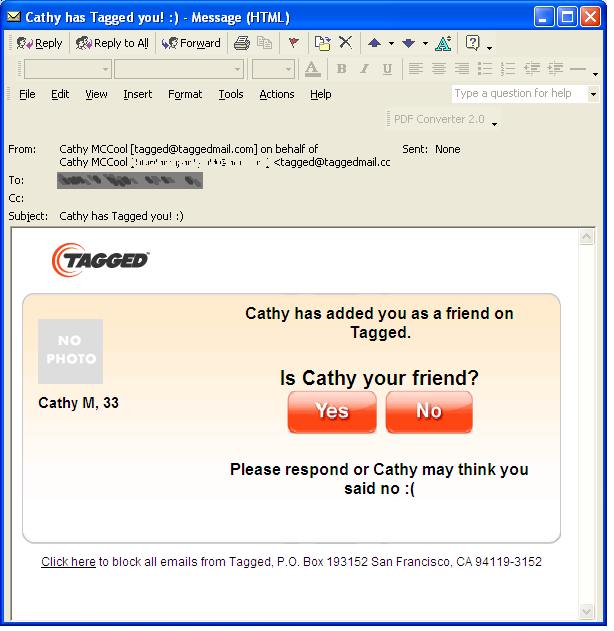
You may have received an email like the one below that looks very authentic, like it came from a friend of yours, via Tagged.com. This email was not sent by your friend or any real acquaintance. It is a scam BY Tagged.com to phish for more people to sign up on Tagged.com
If you receive an email similar to the one below, DO NOT click on the link, and do not enter any information on the forms there.
When you enter the information they ask for, you will simply be handing the spammers the keys to your email accounts. That is how this type of phishing works. Other blogs have reported that Tagged Inc. scoops up your personal email addresses by manipulating the you, unsuspecting user, into entering your Google account information - something you should never, ever do. Invitation messages are then sent to everyone in your contact list are sent without the possibility of you choosing which "friends" you want to "tag".
Remember, there's risk in giving your personal details, even just your email address to social network websites". And no reputable business would send you an email requesting your personal account information for its own or any other service. Any such email you receive asking for this information should be considered phony and brought to the attention of the business being 'phished'.
Anytime you need to go to a website for your bank, credit card companies or other personal, financial or confidential information; do not follow a link in an email; just type their address in your browser directly
Below are actual phishing emails that started circulating in 2007. We have put a warning over the links to the phisher's website.
Who is Tagged.com?
IP's of the Tagged'd servers.
64.125.115.5
64.125.115.6
The registered owner is "Tagged, LLC"
Address is a PO box in San Francisco.
Tagged.com is a social networking site. During registration, they ask applicants to supply an
The emails sent by Tagged.com often claim that the recipients have
been "added as a friend," "sent photos" or "sent a private message" on
Tagged.
I clicked on the link and entered information, What will happen now?
You'll probably get a LOT more spam and other junk email. Anyone in your address book of the email account your supplied to Tagged may receive email messages from Tagged, without your knowledge.
What can I do about it?
Write back to the person who is referenced in the Tagged.com email (but write to them directly, not through Tagged.com) and tell them what happened. Ask them to cancel their Tagged.com account and complain to Tagged.com.
You may want to complain to:
- the U.S. government's Internet Crime Complaint Center (IC3) at Internet Fraud Complaints Center.
- your state's attorney general's office. See this page to find your state's office.
You can also complain to Tagged.com's ISP/hosting company (Internet Service Provider, the company that puts their website on the internet).
They may change hosts often, so the best way to find out who is hosting Tagged.com is to go to http://whois.domaintools.com/tagged.com
You can also use any one of the free resources below to determine current network provider of tagged.com/taggedmail.com:
http://www.dnstrouble.com/
http://thednsreport.com/
http://mydnstools.info/
http://dnsbench.com/
http://www.iptools.biz/
http://who.is/
https://ws.arin.net/whois
http://www.spamhaus.org/sbl
For more information about phishing, see this page.
Example
Here is one account of what happens if you click on the links in the email (see this blog for the complete account):
It took some generic contact details from me, then informed me who else in my email list is also a member. I figured, sure, I will add them to the set, since they are already involved. But one thing I did NOT want to do was spam all my friends - I KNOW who my friends are and I don't need a stupid internet network to tell me who they are. I hit send;
Then I scrolled down as I waited for the next page to load.
And discovered it had not just flagged the people in the system but flagged EVERY SINGLE PERSON I HAVE EVER EMAILED for an invitation to this stupid network!
I had messages going out to customer service departments of a dozen companies, billing companies, former clients, casual acquaintances, my PASTOR, my professors! I tried to cancel it, but it was too late.
For the next two days I spent my email time replying to all my friends who were ticked off at me for sending them this spam. And explaining myself to countless people who hardly knew me, wondering why I was being such a twit as to beg them to call themselves my friend.
Then the 2nd round started.
Tagged.com RE-EMAILED everyone after 3 days! Begging them again! My gosh! How pathetic is this thing?
I logged into my account and scoured it, to find out how to turn off these stupid spam messages. There was no way. I closed my account and told Tagged.com EXACTLY what I thought of this system.
Avoid Tagged.com at all costs. Reply directly to any of your friends who send this to you, telling them yes, you are their friend, but no you will not join any spamming network to prove it.
References:
- eWeek, April 2007
- McAfee SiteAdvisor - read the user reviews
You can read another description here, and find plenty more in a quick Google search of "Tagged.com"
Here are links to a few of the many, many examples of people who have been scammed and phished by and through Tagged.com:
- The Spam Diaries: Don't give your password to Tagged.com
- tagged.com,dating site - was reported to Scam Club
- Arhhhh! Tagged.com got me | www.nickhodge.com
- Romance Scam - Last comments
- Avoid Tagged.com like the plague (wake up!)
- StumbleUpon - Tagged
- Tagged.com Warning!<
- Crime Online: Grace Migwor sent me this on Tagged.com
- Tagged Turns Profitable - May Be Fastest Growing Social Network
Conclusion: Tagged .com and Other Social Networking Sites Are Not Worth the Risks
If you really don't believe that entering a profile on social networking websites, like tagged.com, Facebook, MySpace and others, endangers many aspects of your privacy, and therefore also your identity, finances and possible safety, then read these comments to the Federal Trade Commission by a researcher, Dr. Jo Rutter. The entire study can be seen here on the FTC website.
"After listening to the webcast of the recent FTC ehavioral sessions on Nov 1-2, 2007, it was apparent that most online entities acknowledge the importance of privacy, but little was resolved in terms of taking real steps toward changes in the corporate attitude toward the fundamental importance of this issue in light of new, and even more profitable ways to use consumer information. 'Privacy speak' was the talk of the day, but real change was lacking. At the time of this seminar, the second study in the presentation was being compiled. In it you will find that if users want to send a simple email to websites to resolve or clarify privacy concerns -- (websites were specifically asked 1) if they share personal info collected on the site? and with whom? and 2) can personal information on the site be permanently deleted?) - consumer centric privacy policies and responsive sites are the exception, not the rule.
Websites say they care, but from this study you will see that is generally an empty statement. In a very recent development, Channel 4 news out of the UK has televised a situation in which a user attempted to permanently delete their account on Facebook.com. Although the individual was permitted to deactivate their account, the information remains on Facebook's servers indefinitely. This specific question was posed to over 105 popular US websites in our second study, as detailed in the attached powerpoint presentation. The results were poor - with most not even willing to address this issue."
You will see in their study that the vast majority of social networking websites, even the most popular and well known ones, don't even bother to answer questions about privacy, and attempting to remove your personal; information is simply ignored. Do you really want your personal information to be posted on the internet forever? STAY OFF SOCIAL NETWORKING WEBSITES!