There are affiliate links on this page.
Read our disclosure policy to learn more.
Text Scam: Did you receive an Text claiming Your profile caught our eye, and we think you'd be a wonderful fit for our part-time remote role
Text and Online Scams -
Have You Received a Scam Text?
Sophia (or ANY name) from the Amazon Recruitment Division, claiming Your profile caught our eye, and we think you'd be a wonderful fit for our part-time remote role
Did you receive an text from Sophia (or ANY name) from the Amazon Recruitment Division, claiming "Your profile caught our eye, and we think you'd be a wonderful fit for our part-time remote role"? Did they then instruct you to "ext 3322936776 to proceed quickly" or something similar?
Well, don't fall for it. It is a scam, and if you call them back or follow their instructions you will lose money and possibly your identity! The people behind this are the worst kind of human scum; willing to do anything to scare, threaten, lie, cheat and steal money from anyone, including the elderly and poor. They usually operate out of Nigeria, China, Russia and even some developed western countries. Attachments typically include malware to infect your computer, tablet or phone and allow the scammer to capture your passwords.
-
Report received:
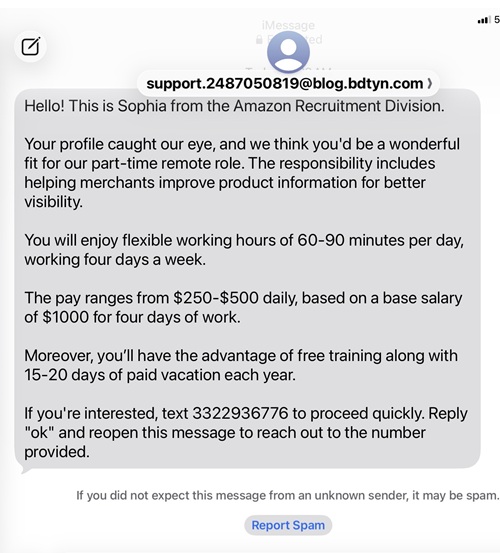 Hello! This is Sophia from the Amazon Recruitment Division.Your profile caught our eye, and we think you'd be a wonderful fit for our part-time remote role. The responsibility includes helping merchants improve product information for better visibility.You will enjoy flexible working hours of 60-90 minutes per day, working four days a week.The pay ranges from $250-$500 daily, based on a base salary of $1000 for four days of work.Moreover, you'll have the advantage of free training along with 15-20 days of paid vacation each year.If you're interested, text 3322936776 to proceed quickly. Reply "ok" and reopen this message to reach out to the number provided.
Information About Sophia (or ANY name) from the Amazon Recruitment Division, claiming Your profile caught our eye, and we think you'd be a wonderful fit for our part-time remote role
There are several websites that focus on reports of scam Texts.
The links below go to pages on these other websites were you can read reports about the scams associated with this phone number (Sophia (or ANY name) from the Amazon Recruitment Division, claiming Your profile caught our eye, and we think you'd be a wonderful fit for our part-time remote role):
- Microsoft Safety and Security Center
- Microsoft Community - Windows Support Scam - I was called by someone who said they were windows support and my computer was sending them warnings and messages!
- ARS Technica
It is a scam
Don't fall for it. It is a scam.
What to do
Just ignore it and delete the text. Do not click on anything in the text.
Apple offers the following advice:
If you get a suspicious Text:
Scammers spoof phone numbers and use flattery and threats to pressure you into giving them information, money, and even iTunes gift cards. Always verify the caller's identity before you provide any personal information. If you get an unsolicited call from someone claiming to be from Apple, hang up and contact us directly.
Tech support scams are an industry-wide issue where scammers use scare tactics to trick you into paying for unnecessary technical support services that supposedly fix contrived device, platform, or software problems.
Scammers may call you directly on your phone and pretend to be representatives of a software company. They might even spoof the caller ID so that it displays a legitimate support phone number from a trusted company. They can then ask you to install applications that give them remote access to your device. Using remote access, these experienced scammers can misrepresent normal system output as signs of problems.
Cybercriminals don't just send fraudulent text messages and set up fake websites. They might also call you on the telephone and claim to be from Microsoft. They might offer to help solve your computer problems or sell you a software license. Once they have access to your computer, they can do the following:
Trick you into installing malicious software that could capture sensitive data, such as online banking user names and passwords. They might also then charge you to remove this software.
See these pages for guidance as applicable to your specific situation:
- If you are certain you don't owe a debt: What to do about harassing Texts
- If you may owe a debt: Debt collection Emails - what they may do, what the may not do and how to stop them
- If you are being harassed by the collector: file a compliant against a debt collector with the FTC - Use this form to submit a complaint to the Federal Trade Commission (FTC) Bureau of Consumer Protection about a particular company or organization..
- How to stop telemarketers
Protect Yourself:
The following documents and websites can help you learn more about phishing and how to protect yourself against phishing attacks.
- Avoiding Social Engineering and Phishing Attacks
- Protecting Your Privacy
- Understanding Web Site Certificates
- Anti-Phishing Working Group (APWG)
- Federal Trade Commission, Identity Theft
- Recognizing and Avoiding Text Scams
Methods of Reporting Phishing Text to the US Government
- In Outlook Express, you can create a new message and drag and drop the phishing email into the new message. Address the message to phishing-report@us-cert.gov and send it.
- In Outlook Express you can also open the email message* and select File > Properties > Details. The email headers will appear. You can copy these as you normally copy text and include it in a new message tophishing-report@us-cert.gov .
- If you cannot forward the email message, at a minimum, please send the URL of the phishing website.
* If the suspicious mail in question includes a file attachment, it is safer to simply highlight the message and forward it. Some configurations, especially in Windows environments, may allow the execution of arbitrary code upon opening and viewing a malicious email message.
For More Information About Phishing, See:
- Click Here for a copy of NCL's Phishing Brochure. Requires Adobe Acrobat Reader'.
-
How Not to Get Hooked by a 'Phishing' Scam
[PDF version]
Offers tips on how to avoid falling victim to a new type of spam scam in which consumers are deceived into handing over personal financial information. -
Is Someone "Phishing" for Your Information? [PDF version]
Cautions consumers about emails that claim to be from government agencies in an attempt to steal personal information. - Digital PhishNet Web site.
- Phish Report Network - a cooperative effort by several companies providing an information clearinghouse that will be run by WholeSecurity, a provider of client-side security solutions.
- Internet Crime Prevention & Control Institute, a cooperative effort between Zero Spam Network Corp. and the University of Miami. Staffed by Miami undergraduate and graduate students and Zero Spam employees, works closely with the Secret Service's Electronic Crimes Task Force and ISPs in the United States and abroad to identify and block traffic to machines hosting phishing sites.
There are several websites that focus on reports of scam Texts and Emails.
The links below go to pages on these other websites were you can read reports about the scams associated with this phone number (855-687-1444, claiming This is Microsoft. This call is to inform you that your Microsoft license key has expired):
- Microsoft Safety and Security Center
- Microsoft Community - Windows Support Scam - I was called by someone who said they were windows support and my computer was sending them warnings and messages!
- ARS Technica
Related Scams
There are a number of common telephone scams, such as:
and some new and as yet, uncommon scams.
For a comprehensive list of national and international agencies to report scams, see this page.